
Where Grab Bars Actually Go—and Why a Towel Bar Won't Do
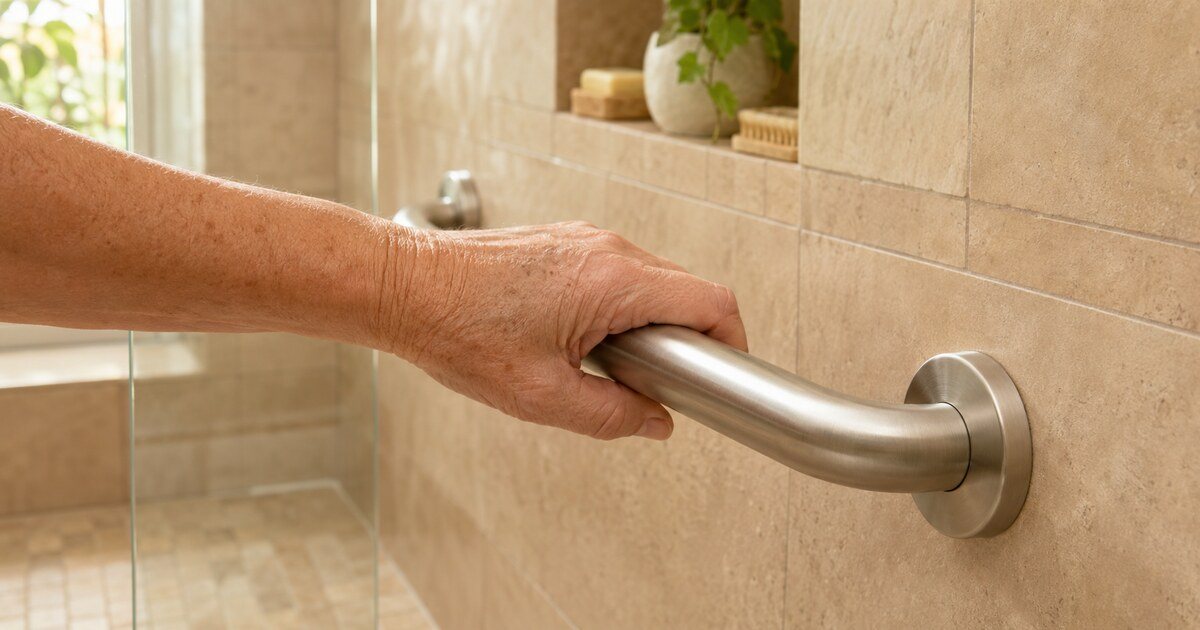
Grab bars generally belong in three places: at the shower or tub entry, inside the bathing area, and beside the toilet. Their exact position should follow the user’s movements and the room’s construction.
A towel bar is not a substitute. It is designed to hold a towel, not a person trying to stop a fall. When someone slips, the nearest bar is the one they will grab. If that bar pulls out of drywall, it can make the fall worse.
The National Institute on Aging specifically recommends grab bars near toilets and in tubs or showers as part of making a home safer for older adults. (National Institute on Aging)
Grab Bar Specifications: A Useful Starting Point
Federal accessibility standards provide established technical benchmarks:
- Diameter: 1.25–1.5 inches
- Height: 33–36 inches above the finished floor
- Clearance: enough space around the gripping surface for a hand to wrap around it
- Strength: bar, fasteners, and mounting structure must resist a 250-pound vertical or horizontal force
These ADA requirements do not automatically govern every private home. They are still useful because they address grip, clearance, position, and structural performance rather than appearance alone. (2010 ADA Standards, sections 505 and 609)
The correct residential installation may differ based on the user’s height, reach, transfer technique, and mobility equipment. Treat the dimensions as informed design context, not a substitute for assessing the resident.
Location 1: At the Shower or Tub Entry
Entering and leaving a bathing area combines a change in level, a wet surface, and a moment when one foot may be unsupported. A vertical or angled bar near the entry can provide a stable handhold during that transition.
Position matters. The bar must be reachable before the user commits weight to the step, not placed beyond the point where balance is already challenged. It must also avoid interfering with a door, curtain, control, or transfer path.
Location 2: Inside the Shower or Tub
Inside the bathing area, a bar can support turning, standing, reaching, sitting, and rising. The best orientation depends on those movements.
A horizontal bar provides support along a path. A vertical bar can support changes in height. An angled bar may follow the motion of sitting and standing, but it should not be installed merely because it looks natural on the wall.
Controls, shower seats, and grab bars should be planned together. A seat that forces the user to lean away from support or reach across a wet space solves one problem by creating another.
Location 3: Beside the Toilet
Toilet transfers often require controlled lowering and enough leverage to stand. A correctly positioned side-wall or rear-wall bar may provide that support.
The relevant questions are practical:
- Which side does the user approach from?
- Is there a wall where support is needed?
- Does a vanity block the hand position?
- Can the user reach the bar before beginning the transfer?
- Would a floor-mounted or fold-down solution be needed where no suitable wall exists?
Avoid choosing a location from a generic diagram without comparing it to the actual transfer.
Why Grab Bar Installation Costs $150—or $2,000
When structural blocking is already behind the wall, installation may cost $150–$300 per bar. Without blocking, the project may cost $800–$2,000 per bar.
The price difference is not primarily the metal bar. It is access to structure. A contractor may need to:
- Open drywall or remove tile.
- Install wood blocking or another approved structural support.
- Close the wall.
- Restore waterproofing where applicable.
- Match texture, paint, or tile.
- Install and test the bar.
That is why grab bar blocking is inexpensive during construction and costly later.
How to Determine Whether Blocking Exists
Do not assume a stud finder has proven that suitable blocking is present. It may identify framing or another dense object without showing its dimensions, condition, or suitability for the proposed fasteners.
Useful evidence can include:
- Construction photographs taken before drywall or tile
- Plans or specifications that explicitly show blocking
- Records from a prior bathroom renovation
- Inspection from an accessible adjacent cavity
- Evaluation by the installer responsible for the final attachment
If the wall assembly cannot be verified, price the work with uncertainty included. Discovering the problem after drilling tile is the expensive version of the conversation.
What About Suction-Cup Grab Bars?
A suction-mounted bar may serve as a light balance cue on a compatible surface. It should not be treated as fall-arrest equipment or as equivalent to a structurally mounted grab bar.
Suction depends on surface condition, cleanliness, seal integrity, product condition, and continued adhesion. A device can appear secure during a quick test and loosen later.
If a person will place body weight on the bar, use a properly selected and structurally installed product. A temporary-looking solution can create false confidence, which is worse than clearly knowing no support is present.
Add Blocking Even If You Do Not Add Bars Yet
During bathroom construction or renovation, wall blocking typically costs $50–$150 per bathroom. It preserves future placement options without requiring visible grab bars today.
Document it. Take photographs with measurements before the wall closes and store them with the home records. Invisible preparation has little value if the future installer cannot locate it.
The Bottom Line
A safe grab bar is not defined by color, brand, or whether it matches the faucet. It must be reachable during the movement that creates risk and connected to structure capable of supporting the load.
Start with the shower entry, inside the bathing area, and the toilet. Then assess the individual movement, the wall, and the installation—not just the product.
For the surrounding project budget, see what it actually costs to make a bathroom safe. The home assessment can identify which locations and related bathroom conditions need attention.