
What It Actually Costs to Make a Bathroom Safe
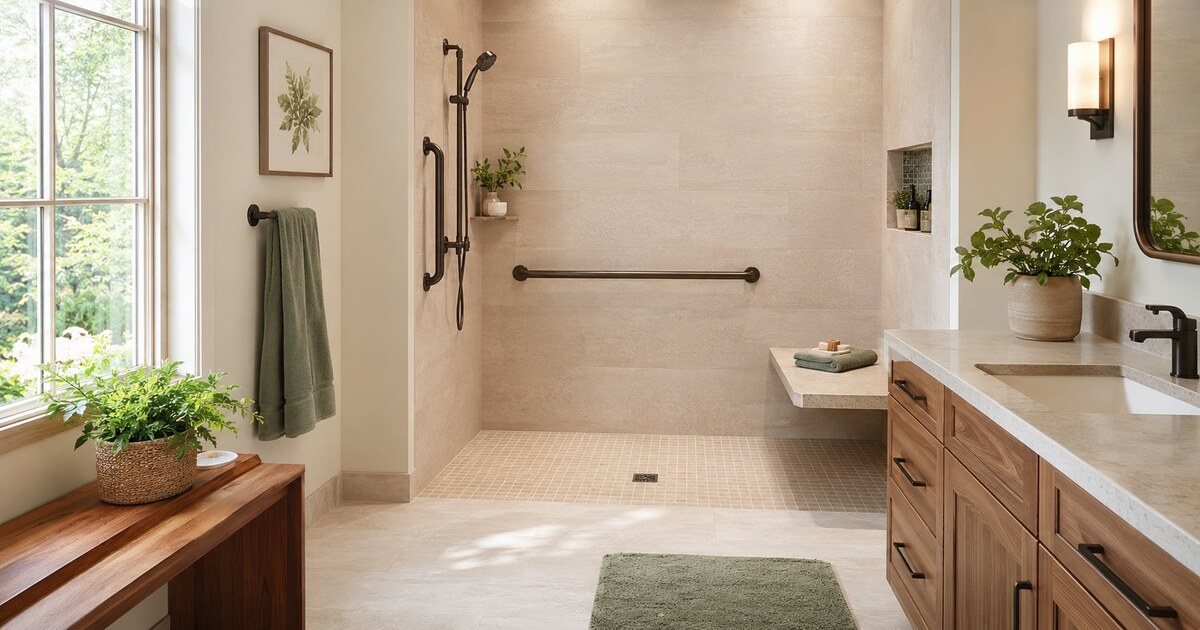
Making a bathroom safer can cost $10 for a rubber-backed mat, $150–$300 for a properly supported grab bar, or $8,000–$25,000+ for a full wheelchair-accessible conversion. The right budget depends on the person and the room. Most households do not need to begin with a complete renovation.
That distinction matters because “bathroom safety remodel” is often treated as one project. It is really a sequence of decisions. A loose rug may need attention today. A curbless shower may be worth planning when the room is remodeled. A full accessible conversion makes sense only when the user and the space require it.
The National Institute on Aging recommends reducing fall hazards, using nonslip surfaces, and installing grab bars near toilets and in tubs or showers. Those measures do not all carry the same urgency or price. (National Institute on Aging)
Bathroom Safety Modification Costs at a Glance
| Modification | Typical planning range | Best fit |
|---|---|---|
| Rubber-backed bathroom rug | $10–$40 each | Immediate slip-risk reduction |
| Raised toilet seat | $25–$100 | Temporary or low-cost transfer help |
| Personal emergency response system | $25–$50 per month | Reaching help after a fall |
| Smart speaker | $50–$200 | Secondary voice-access option |
| Grab bar with existing blocking | $150–$300 per bar | Stable support at transfers |
| Grab bar without blocking | $800–$2,000 per bar | Retrofit requiring wall work |
| Comfort-height toilet | $200–$600 | Easier sitting and standing |
| Shower seat retrofit | $300–$800 | Reduced standing in the shower |
| Curbless shower retrofit | $4,000–$8,000 | Removing the shower threshold |
| Full accessible conversion | $8,000–$25,000+ | Wheelchair access or extensive needs |
These are planning ranges, not bids. Labor, finishes, wall construction, plumbing, and local requirements can change the final cost.
Start With the Floor: $10–$40
A bathroom rug is inexpensive, but it is not harmless if it slides, bunches, or curls at the edge. Replace loose rugs with rubber-backed versions and make sure they lie flat. If the floor itself becomes slick when wet, a rug alone does not solve the underlying problem.
This belongs first because it is fast, cheap, and does not require a contractor. CDC guidance similarly recommends removing throw rugs or securing them with nonslip backing or double-sided tape. (CDC home fall-prevention checklist)
Make Sure Help Is Reachable: $25–$50 per Month
A personal emergency response system generally costs $25–$50 per month. A smart speaker may cost $50–$200 and can provide a second way to call for help.
The important question is not whether a device is mounted in the bathroom. It is whether the person can activate it from the floor, while wet, hurt, disoriented, or unable to stand. A wall button that can only be reached while standing may fail in the exact situation it is meant to address.
Wearable buttons usually provide more consistent access than a phone left on a counter. A voice assistant can add redundancy, but it depends on power, Wi-Fi, correct setup, and the user being able to speak clearly enough for the device to respond.
Grab Bars: $150–$300—or $800–$2,000
With suitable wall blocking already in place, a grab bar may cost $150–$300 per bar. Without blocking, installation may rise to $800–$2,000 per bar because the contractor may need to open the wall, add reinforcement, repair the surface, match the texture, and repaint or retile.
Proper grab bars are not interchangeable with towel bars. A towel bar holds towels. A grab bar must provide dependable structural support.
Useful technical benchmarks from federal accessibility standards include a gripping surface 1.25–1.5 inches in diameter and a mounting height 33–36 inches above the finished floor. The standards also require grab bars and their fasteners to resist a 250-pound vertical or horizontal force. Although ADA rules do not automatically govern every private residence, the specifications provide valuable design context. (2010 ADA Standards, sections 505 and 609)
Placement should respond to how the resident enters the shower, turns, sits, stands, and transfers—not merely where a bar looks symmetrical.
For a detailed placement guide, see Where Grab Bars Actually Go.
Raised Seat or Comfort-Height Toilet?
A raised toilet seat costs about $25–$100. It is the cheaper interim option and may be enough for a temporary injury or modest difficulty standing.
A comfort-height toilet generally costs $200–$600. It is a more permanent fixture and avoids some of the fit, stability, and cleaning problems that can come with removable equipment.
Higher is not automatically better. A toilet that helps one person stand may leave a shorter user with feet that do not rest securely on the floor. The decision should reflect the primary user’s height, strength, balance, and transfer method.
Shower Seat: $300–$800
A shower seat retrofit typically costs $300–$800. A fixed or fold-down seat can reduce the time spent standing on a wet surface, but it also introduces a structural requirement: like a grab bar, a wall-mounted seat needs dependable support.
Freestanding seats may be appropriate in some bathrooms, but they must fit the shower footprint without creating a new obstruction. The user still needs a stable way to enter, turn, and reach controls.
Curbless Shower: $4,000–$8,000
A curbless shower removes the raised threshold at the shower entrance. Retrofitting one generally costs $4,000–$8,000 because the work can involve demolition, drainage, waterproofing, floor slope, tile, and transitions outside the shower.
If the bathroom is already being substantially remodeled, building the curbless entry at that time may add only $500–$1,500. That is the useful planning decision: coordinate accessibility work with renovation work that is already opening the floor and walls.
Curbless does not mean careless. The shower still needs correct drainage, waterproofing, nonslip surfaces, reachable controls, and enough clear space for the intended user.
Full Wheelchair-Accessible Conversion: $8,000–$25,000+
A full accessible bathroom conversion typically costs $8,000–$25,000+. It may include doorway widening, circulation clearance, fixture relocation, an accessible shower, reinforced walls, reachable storage, and plumbing or electrical changes.
This level of work is justified when the resident uses a wheelchair or the current layout makes essential transfers impossible. It is excessive when the real problems are a loose rug, poor lighting, a difficult toilet transfer, and one unsupported shower entry.
The goal is not to buy the most modifications. It is to remove the actual barriers.
What Order Should Bathroom Safety Upgrades Follow?
| Priority | Action | Why it comes here |
|---|---|---|
| 1 | Remove or replace loose rugs | Immediate, inexpensive hazard reduction |
| 2 | Confirm a reachable way to call for help | Limits the consequences of a fall |
| 3 | Install correctly placed grab bars | Supports shower and toilet transfers |
| 4 | Address toilet height | Often solvable without remodeling |
| 5 | Add a suitable shower seat | Reduces standing on a wet surface |
| 6 | Plan a curbless shower with other renovation | Avoids paying twice for demolition |
| 7 | Convert the full room when access requires it | Structural work should answer a demonstrated need |
This is a general sequence, not an individual prescription. A person who cannot enter the shower safely may need structural work before smaller conveniences. A person who has already fallen may need a clinical fall-risk review alongside changes to the house because falls usually result from several interacting factors, not one loose object. (CDC facts about falls)
The Bottom Line
For many households, the first meaningful bathroom changes cost hundreds rather than thousands: secure the floor, make help reachable, support the key transfers, and adjust toilet or shower seating.
The larger expense arrives when finished walls and floors must be reopened. If a remodel is already planned, add wall blocking and coordinate the curbless shower then. Building support before the walls close preserves options at a fraction of typical retrofit cost.
The home assessment checks eight bathroom conditions and helps identify which changes should come first for the person and the room.